 Eduardo Sifuentes
Key Takeaways:
- Market cap, P/E ratio, and yield are three of the most commonly misunderstood investing terms
- A ‘basis point’ is 1/100th of a percentage point — the exact unit the Fed uses for rate moves
- Understanding this vocabulary makes most financial headlines far easier to parse
Financial news assumes you already know the vocabulary. Here’s the cheat sheet.
- Market cap — a company’s total value: share price × total shares outstanding.
- Bull/bear market — sustained rising (bull) or falling (bear, typically -20%+) markets.
- Volatility — how sharply and how often prices swing, regardless of direction.
- Liquidity — how easily an asset can be bought or sold without moving its price.
- Dividend — a portion of profit a company pays directly to shareholders, usually quarterly.
- P/E ratio — price-to-earnings ratio, used to gauge whether a stock is “expensive” relative to its profit.
- Basis point — 1/100th of a percentage point; the unit the Fed uses for rate moves.
- Yield — the income return on an investment, usually expressed as an annual percentage.
- Blue chip — shorthand for large, financially stable, well-established companies.
- Index fund — a fund built to mirror an entire index rather than picking individual stocks.
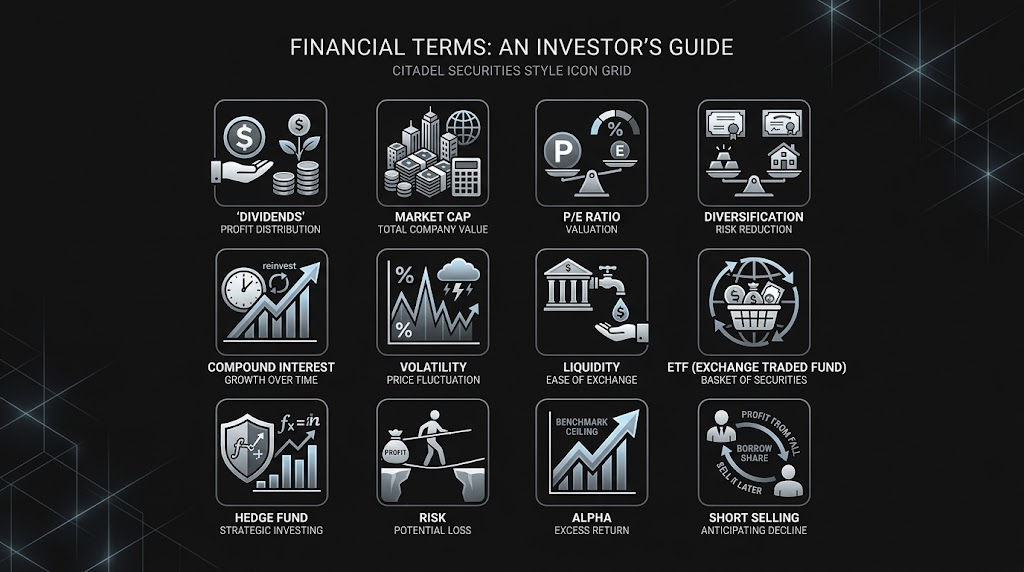
Why This Vocabulary Matters: None of these terms are complicated alone — the confusion comes from articles assuming you already know them. With this list, most headlines become far easier to parse.
Source: investor.gov, News.
Frequently Asked Questions (FAQ)
A company’s total value, calculated as share price multiplied by total shares outstanding.
Price-to-earnings ratio — share price divided by earnings per share, used to gauge if a stock is expensive relative to its profit.
One-hundredth of a percentage point; the unit the Federal Reserve uses when describing rate changes.
A bull market is a sustained period of rising prices; a bear market is typically a decline of 20% or more.
How easily an asset can be bought or sold without significantly moving its price.
A portion of company profit paid directly to shareholders, usually on a quarterly basis.
A fund built to mirror an entire index, like the S&P 500, rather than picking individual stocks.
How sharply and how often an asset’s price swings, regardless of direction.
Shorthand for large, financially stable, well-established companies.
Most market headlines assume you already know these terms, so learning them makes coverage far easier to follow.