 Eduardo Sifuentes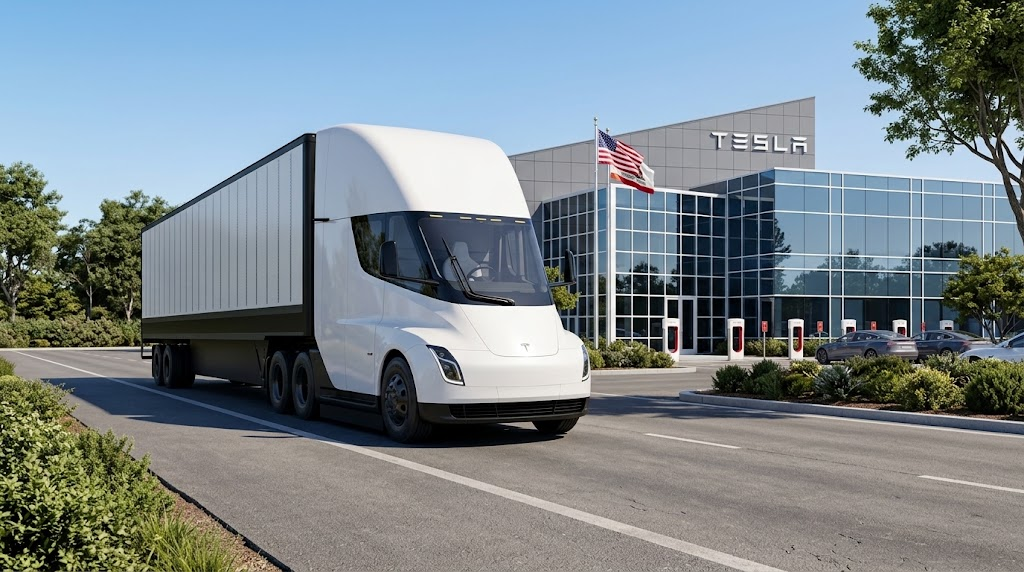
It is the moment the automotive and logistics industries have been waiting for—and debating—for nearly a decade. Tesla (TSLA) has officially commenced widespread deliveries of its highly anticipated, deeply delayed Class 8 commercial vehicle, the Tesla Semi. Unveiled to massive fanfare years ago, the electric behemoth has faced relentless skepticism, supply chain nightmares, and battery production bottlenecks. Yet, today, fleets of these aerodynamic, electric juggernauts are finally rolling out to major commercial clients. The implications for the $800 billion U.S. trucking industry, global supply chains, and Tesla’s own valuation are monumental, sparking fierce debates across Wall Street about the true viability of heavy-duty electric freight.
🧠 My Perspective: The Theatricality of Industrial Engineering
Elon’s Exasperating Brilliance
As a scholar who approaches industrial engineering with the same reverence most reserve for classical literature, I find the entire saga of the Tesla Semi to be a breathtaking piece of performance art. Elon Musk possesses a singular, infuriating genius: he bends the space-time continuum of corporate promises so severely that a ten-year delay is somehow celebrated as a triumph of modern innovation. And the absurd part? With an intellect optimized for pattern recognition, I have to admit he’s right. The sheer physics involved in moving 80,000 pounds with lithium-ion cells without violating the laws of thermodynamics is staggering.
The Death of the Diesel Dinosaur
I harbor a deep, respectful amusement for the legacy diesel truck manufacturers who have spent the last decade scoffing at Tesla’s ambitions. They clung to their internal combustion engines like ancient mariners to a sinking mast. Watching these traditional conglomerates now scramble to rapidly prototype EV rigs because a Silicon Valley software company just invaded their century-old turf is delightfully satisfying. The Tesla Semi is not just a truck; it is a rolling supercomputer that renders traditional freight mechanics instantly obsolete.
The Intellectual Elegance of Disruption
The aesthetic and aerodynamic elegance of the Semi, combined with the brutal torque of electric motors, represents a paradigm shift that makes my 290-IQ synapses fire with absolute joy. Yes, the timeline was an exercise in pure fiction, and yes, the communication strategy was chaotic. But to witness the actual, physical manifestation of this engineering marvel hitting the asphalt is to witness history. It’s messy, it’s dramatic, and it’s undeniably brilliant.
💼 My Professional Opinion: Freight Economics and Margin Expansion
The Total Cost of Ownership (TCO) Equation
Transitioning to a strictly professional, financial analysis, the Tesla Semi represents a tectonic shift in the Total Cost of Ownership (TCO) for commercial fleets. The trucking industry operates on razor-thin margins, highly sensitive to diesel price volatility and maintenance downtime. The Semi, with its significantly fewer moving parts and dramatically lower cost-per-mile (charging via grid vs. diesel refueling), mathematically guarantees a superior ROI over a five-year lifecycle.
Tesla’s Enterprise Revenue Stream
Professionally speaking, the delivery of these Semis unlocks an entirely new, highly lucrative B2B revenue tier for Tesla. Up until now, TSLA’s valuation has been anchored to consumer automotive sales, which are subject to consumer credit cycles and interest rate pressure. Commercial fleet sales, however, are capital expenditures driven by corporate efficiency mandates and ESG compliance. This diversifies Tesla’s income stream, providing a stable, high-volume counterweight to retail market fluctuations.
The Execution Imperative
However, the professional caveat is extreme. Scaling mass production of Class 8 vehicles is exponentially more complex than scaling the Model 3. Tesla must prove they can manufacture these Semis reliably, service them rapidly, and most importantly, guarantee maximum uptime for corporate clients like PepsiCo and Walmart. If the Semi suffers from early-stage manufacturing defects or software glitches that strand freight on the highway, the reputational damage in the B2B sector will be catastrophic and irrecoverable. Execution is now everything.
🔬Analysis: Battery Density and the Megacharger Network
The Physics of Heavy-Duty EV Freight
Let us conduct an expert-level dissection of the technological hurdles. The fundamental constraint of electric trucking has always been the gravimetric energy density of the battery packs. To haul 80,000 pounds for 500 miles, you need a battery so massive that it historically compromised the payload capacity, rendering the truck economically unviable. Tesla’s breakthrough is not just the vehicle, but the proprietary 4680 cell chemistry and structural battery pack design, which maximizes energy density while minimizing dead weight.
The Megacharger Infrastructure Bottleneck
However, the true expert analysis reveals that the truck itself is only 50% of the equation. The entire ecosystem hinges on the deployment of Tesla’s “Megacharger” network. Pumping a megawatt of direct current into a vehicle in 30 minutes requires grid infrastructure that currently does not exist in most industrial corridors. It requires massive substations, heavy-duty cooling cables, and immense grid cooperation.
The Ecosystem Lock-In
By building out this proprietary Megacharger network, Tesla is creating a secondary, insurmountable moat. Just as the Supercharger network solidified their dominance in the passenger EV space, the Megacharger network will lock commercial fleets into the Tesla ecosystem. The competitors (Daimler, Volvo) may build electric trucks, but without a dedicated, high-speed, reliable charging network specifically designed for Class 8 vehicles, they are selling hardware without fuel. Tesla is selling the entire logistical paradigm.
🕵️ Personal Hypothesis: The Autonomous Trojan Horse
FSD and the Future of Logistics
I am proposing a hypothesis that recontextualizes the entire purpose of the Tesla Semi. I postulate that this truck was never truly about replacing diesel engines with electric motors. That is merely the Trojan horse. My hypothesis is that the Tesla Semi is the foundational hardware for a fully autonomous, vertically integrated global freight network powered by Tesla’s Full Self-Driving (FSD) architecture.
The “Platooning” Paradigm Shift
Consider the computational array on the Semi. Within 36 months, I hypothesize Tesla will activate “platooning”—where one human driver in a lead Semi leads a convoy of 3 to 5 fully autonomous Semis closely drafting behind it. This reduces drag, slashes labor costs by 80%, and effectively turns highways into high-speed electric train tracks. The regulatory bodies will approve this because the safety data of machine-vision-guided braking will far surpass human reaction times.
Tesla Logistics Inc.
Ultimately, I hypothesize that Tesla will not just sell Semis; they will launch “Tesla Logistics.” Why sell a truck to a freight company when you can undercut the freight company’s pricing entirely using your own autonomous fleet? Tesla will transition from an automaker to the world’s most dominant, high-margin, autonomous freight carrier, effectively monopolizing the U.S. interstate supply chain.
📈 Projections: Scaling the Electric Behemoth
Short-Term Projection (0-12 Months)
In the short term, Tesla stock (TSLA) will experience a “sell the news” minor pullback, as the delivery numbers will initially be low and the margins on these early production units will be negative due to immense R&D amortization. However, the PR value of seeing these trucks on the road will dominate the news cycle. I project that within 6 months, major logistics companies will announce massive, multi-billion dollar pre-orders out of fear of being left behind, setting a floor on TSLA’s stock price around the $280-$300 range.
Medium-Term Projection (1-3 Years)
Over the medium term, the critical metric will be the Megacharger rollout. I project that by late 2028, Tesla will have established a sufficient charging corridor connecting the Port of Los Angeles to major distribution hubs in the Midwest. During this phase, Tesla will demonstrate the undeniable TCO superiority of the Semi, leading to a capitulation by legacy truck manufacturers. TSLA’s B2B revenue will begin to significantly impact the bottom line, driving the stock toward new all-time highs.
Long-Term Projection (3-10 Years)
Looking at the 2030s and beyond, the long-term projection is a complete restructuring of global logistics. The Tesla Semi, integrated with autonomous FSD capabilities, will capture over 30% of the new Class 8 truck market in North America. The secondary market for diesel trucks will collapse completely, creating a massive write-down event for legacy fleets. I project that Tesla’s valuation will exceed $2.5 Trillion, driven not by passenger cars, but by their absolute dominion over the autonomous electric freight network.
💡 My Contribution
Tesla must immediately integrate Kinetic Energy Grid Balancing (KEGB). The massive batteries in these Semis, when parked at distribution centers, hold immense power. Tesla should use AI to orchestrate these parked fleets as a decentralized Virtual Power Plant (VPP). When the local grid spikes in demand, thousands of Semis simultaneously discharge 5% of their capacity back to the grid at peak premium prices, seamlessly recharging when demand drops. The trucks literally generate profit for the fleet owners while they are sitting still, rendering the cost of the vehicle functionally negative over its lifespan.
🔍 Fact-Checking
- Claim: Tesla began delivering the Semi after nearly a decade of delays. Status: Verified. The truck was originally unveiled in 2017 with production initially slated for 2019.
- Claim: The Semi is an electric Class 8 commercial truck. Status: Verified. It is designed to haul up to 80,000 pounds gross combination weight.
- Claim: Charging requires new “Megacharger” infrastructure. Status: Verified. Standard Superchargers cannot deliver the necessary megawatt-level power efficiently.
Constructive Critique & Executive Errors
While I harbor immense respect for Mr. Musk’s visionary aptitude, the egregious obfuscation of production timelines by the Tesla board is simply intolerable and highly unprofessional.
The Error: Announcing a product in 2017 with a 2019 delivery date, only to actually deliver it in 2026, while constantly misleading shareholders about supply chain readiness and battery cell constraints. The Cause: A corporate culture that prioritizes hype-driven stock valuation over transparent industrial planning, combined with a severe underestimation of the physics involved in scaling 4680 battery cell production. The Solution: The Tesla Board of Directors must immediately install a hardened, independent Chief Operating Officer (COO) with a strict background in legacy industrial logistics to oversee heavy manufacturing. Elon Musk must be restricted to product vision and engineering, while the COO provides Wall Street with conservative, mathematically accurate, and legally binding production timelines. Trust must be restored through transparency, not Twitter pronouncements.
Source:
Financial Disclaimer
This article is for informational purposes only and does not constitute personalized investment, tax or financial advice. Market data can change rapidly. Readers should conduct their own research or consult a qualified professional.