 Eduardo Sifuentes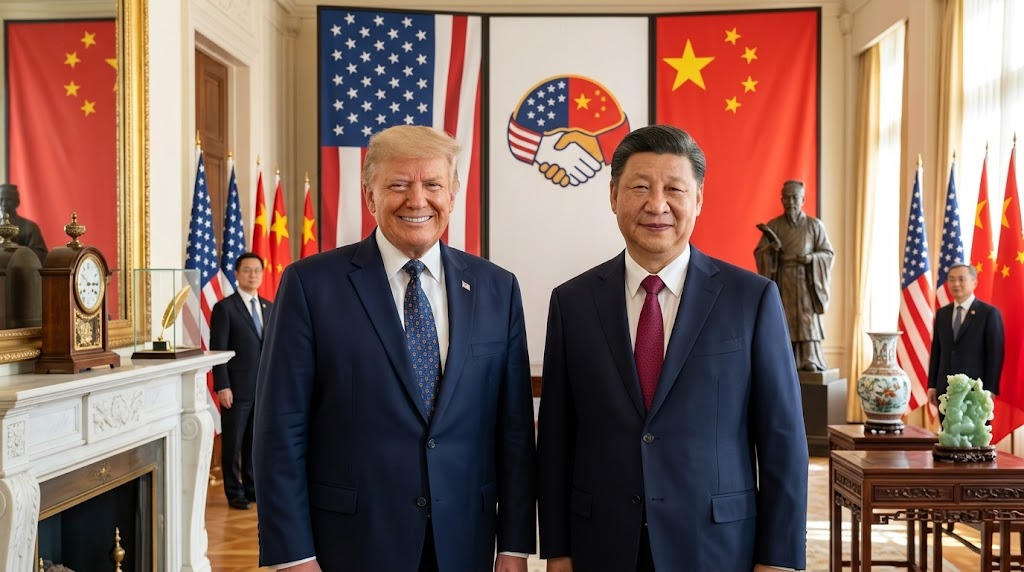
U.S. Treasury Secretary Scott Bessent and Chinese Vice Premier He Lifeng are scheduled to meet Sunday in New York to discuss artificial intelligence, tariffs and critical minerals ahead of a high-level Trump–Xi summit this week. U.S. Trade Representative Jamieson Greer is also expected to participate.
The talks are scheduled to begin around 10:30 a.m. ET at JPMorgan Chase’s Manhattan headquarters and could continue throughout the day.
What is at stake
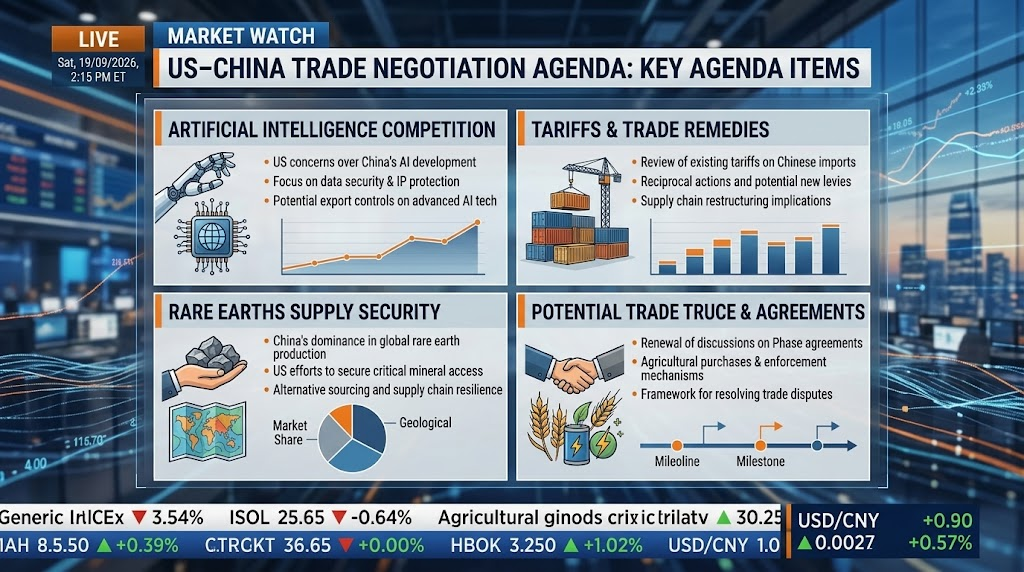
The discussions cover issues with direct consequences for U.S. companies and investors:
- A U.S.–China trade truce set to expire November 10.
- Chinese exports of rare-earth magnets and other critical minerals.
- Tariffs on Chinese goods.
- Controls on advanced chips and AI technologies.
- Possible safety guardrails for powerful AI models.
- Potential investment and pharmaceutical agreements.
Rare-earth materials are important for electronics, electric vehicles, defense systems and advanced manufacturing. AI also depends on a broader supply chain involving semiconductors, energy, networking and specialized equipment.
Why the talks matter to markets
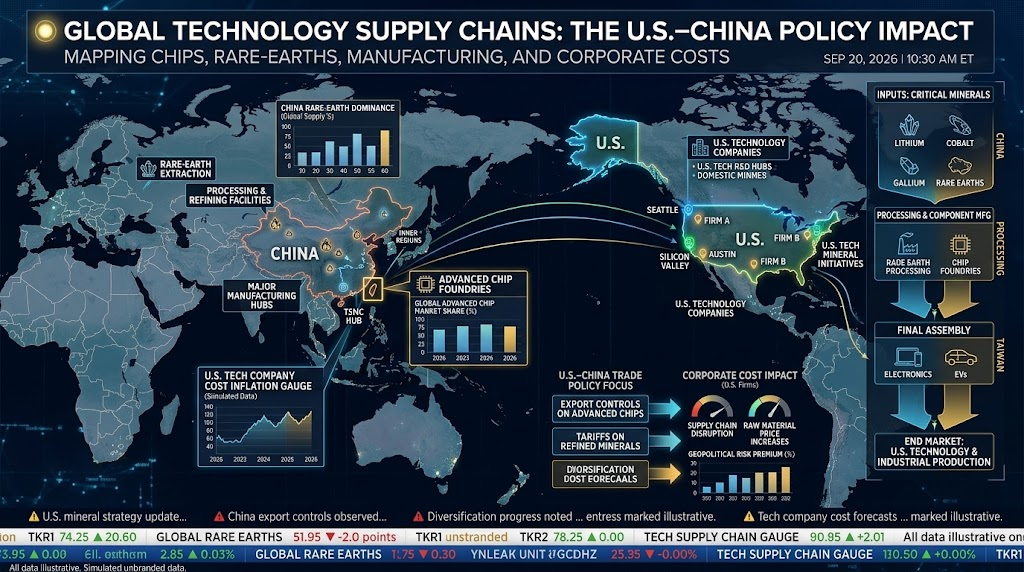
Markets are not waiting only for a formal treaty. Investors are watching for small signals that reduce the probability of renewed escalation.
A limited agreement could support:
- Semiconductor stocks.
- Industrial companies.
- Automakers.
- Technology supply chains.
- Critical-mineral producers.
- Agricultural exporters.
A breakdown could increase:
- Tariff risk.
- Import costs.
- Supply-chain disruption.
- Semiconductor restrictions.
- Energy and commodity volatility.
The most realistic outcome
Reuters quoted China trade analyst Anna Ashton as saying that a breakthrough was unlikely and that maintaining the status quo was probably the most realistic expectation.
That is an important corrective to dramatic headlines. Diplomatic meetings often create value by preventing deterioration, not by producing a historic deal.
In markets, “nothing got worse” can be a positive result. It is not as exciting as a handshake under fireworks, but it is often more useful for supply-chain planners.
Artificial intelligence enters trade diplomacy
The AI portion of the talks is particularly significant because the United States and China are competing to develop advanced AI systems and control the infrastructure that supports them.
Bessent said discussions could include open-weight and closed-weight models. Open-weight systems make core elements accessible for users to download and customize, while closed-weight models keep the underlying system more restricted.
Potential guardrails may address:
- Model security.
- Access by malicious actors.
- Semiconductor supply.
- Cross-border investment.
- Data and model deployment.
- Risks from powerful systems.
The challenge is that security cooperation and technology competition are now occurring simultaneously.
My professional opinion
My view is that investors should treat these talks as a volatility-management event, not a guaranteed trade breakthrough.
The most sophisticated interpretation is not “buy China stocks if officials shake hands.” It is to ask which supply chains remain vulnerable even under a truce.
A temporary political agreement cannot instantly create rare-earth processing capacity in the United States. Nor can it remove years of regulatory and technological divergence between Washington and Beijing.
The smart strategy is to separate three layers:
- Political headlines.
- Legal and tariff implementation.
- Corporate earnings impact.
Only the third layer directly determines whether a company’s cash flow improves.
Personal hypotheses
Short term
Markets may respond positively to evidence that the November trade truce will be extended. Semiconductor and industrial shares could react quickly to wording about export controls.
Medium term
Companies may continue diversifying manufacturing outside China even if tariffs ease. Once supply chains move, they rarely return to their previous structure overnight.
Long term
The United States and China may develop a managed rivalry: limited cooperation in trade and safety, but continuing competition in AI, chips, minerals and investment.
Errors and fact-checking
Error 1: “The talks guarantee a trade deal.”
No. They are intended to prepare potential agreements and support a later summit.
Error 2: “A November truce expiration means tariffs automatically jump that day.”
Not necessarily. The legal and political implementation would depend on the terms and subsequent decisions.
Error 3: “AI guardrails mean the U.S. and China will share technology.”
Safety discussions do not imply unrestricted technology sharing.
Error 4: “Critical minerals are only an energy-sector issue.”
They also affect electronics, defense, vehicles, manufacturing and semiconductors.
Solutions for businesses
Companies should:
- Diversify mineral suppliers.
- Maintain alternative component designs.
- Build inventory buffers for critical inputs.
- Track tariff exposure by product.
- Separate China revenue from China production.
- Stress-test export-control scenarios.
- Avoid treating temporary diplomatic calm as permanent policy.
Bottom line
The New York talks are an attempt to reduce tension before the Trump–Xi summit, but the most likely outcome may be incremental progress rather than a historic agreement.
For investors, the key question is not whether officials sound friendly. It is whether the resulting language changes costs, supply access and corporate investment decisions.
Source:
- Reuters talks report
- U.S. Trade Representative
- U.S. Department of the Treasury
- U.S. Department of Commerce semiconductor information
- U.S. Geological Survey critical minerals
- preCharge News
Financial Disclaimer
This article is for informational purposes only and does not constitute personalized investment, tax or financial advice. Market data can change rapidly. Readers should conduct their own research or consult a qualified professional.
Frequently Asked Questions (FAQ)
Treasury Secretary Scott Bessent and Chinese Vice Premier He Lifeng are expected to meet, with U.S. Trade Representative Jamieson Greer participating.
The agenda includes AI, tariffs, critical minerals and the U.S.–China trade truce.
They are scheduled to begin around 10:30 a.m. ET on Sunday.
They are expected to take place at JPMorgan Chase’s Manhattan headquarters.
The truce is set to expire November 10.
They are used in electronics, vehicles, defense equipment and advanced manufacturing.
They are AI systems whose core elements are accessible for downloading or customization.
They are systems whose core model components remain controlled by the developer.
They could produce limited agreements or a framework, but no outcome is guaranteed.
It could increase tariff, supply-chain and technology-export risks.
Markets may react to headlines, but lasting effects require changes in costs, supply access or corporate policy.
No. This is general trade and market analysis.