 Eduardo Sifuentes
Amazon has agreed to purchase up to $8 billion worth of backup generators from Generac for data centers, revealing a growing constraint behind the artificial-intelligence boom: computing capacity is useless without reliable electricity.
The agreement includes approximately $2.4 billion of initial deliveries scheduled for 2027 and 2028. Amazon also received warrants to purchase up to roughly 1.69 million Generac shares at an exercise price of $200.9266 per share.
What the deal includes
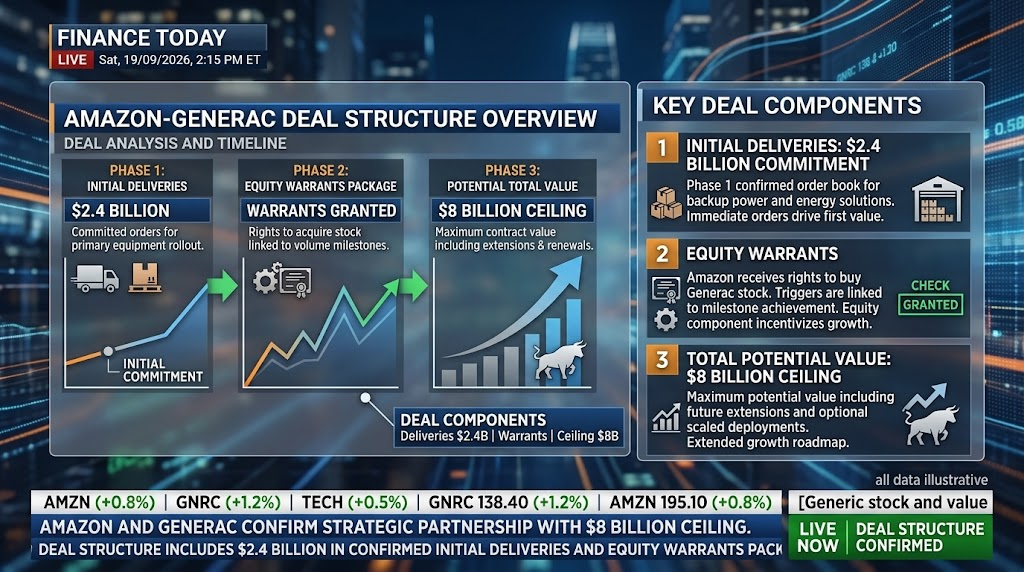
The agreement has a potential value of up to $8 billion through September 16, 2033. The full amount is not an order already booked as revenue.
The key components are:
- Up to $8 billion in potential generator purchases.
- Approximately $2.4 billion of initial deliveries in 2027–2028.
- Warrants for up to about 1.69 million Generac shares.
- An exercise price near $200.93 per share.
- Vesting tied to payments and delivery milestones.
That distinction matters. A maximum contract value is not the same as guaranteed revenue, profit or cash flow.
Why Amazon needs backup power
AI data centers consume enormous amounts of electricity. Grid connections can take years, especially in regions where transmission capacity, permitting and generation are constrained.
Backup generators can:
- Protect operations during outages.
- Support data-center commissioning.
- Improve reliability.
- Reduce dependence on immediate grid upgrades.
- Provide temporary or supplemental power.
They do not solve every energy problem. Generators require fuel, maintenance, emissions compliance and careful integration with the power system.
What it means for Generac
Generac has traditionally been associated with residential and commercial backup power. The Amazon deal could accelerate its shift toward large industrial and data-center customers.
The market rewarded the announcement aggressively. Generac shares rose as much as 35% in one report, while another cited an approximately 18% move during market hours.
The different figures may reflect different timestamps or trading sessions. Always use official closing data in the final version.
My professional opinion
My view is that the deal is strategically more important than the headline dollar amount.
The headline says “$8 billion.” The deeper message is that Amazon is treating electricity reliability as a strategic AI resource.
That should make investors ask an uncomfortable question: if the world’s largest technology companies need industrial generators to accelerate data centers, is the AI bottleneck really chips—or is it power?
My answer is: increasingly, it is both. Chips determine computational density; electricity determines whether that computation can operate at scale.
Personal hypotheses
Short term
Generac shares may remain volatile as investors debate how much of the $8 billion ceiling becomes actual revenue and how quickly margins develop.
Medium term
Demand for data-center backup power could benefit generator makers, electrical equipment companies, grid contractors and fuel suppliers.
Long term
AI infrastructure may encourage a hybrid energy architecture involving grid power, batteries, generators, microgrids and renewable generation. The winners may be companies that integrate the entire system rather than sell one component.
Errors and verification
Error 1: “Amazon ordered $8 billion immediately.”
The agreement has a ceiling of up to $8 billion; initial deliveries are approximately $2.4 billion for 2027–2028.
Error 2: “The warrants are free shares.”
They are options to buy shares at a specified price, subject to vesting conditions.
Error 3: “Generators solve data-center power constraints permanently.”
They provide backup or supplemental power but do not eliminate transmission, fuel, emissions or permitting issues.
Error 4: “Generac’s stock rise proves the deal is fully priced in.”
A price move reflects expectations at one moment, not long-term profitability.
What could go wrong
- Data-center construction delays.
- Equipment shortages.
- Higher manufacturing costs.
- Environmental restrictions.
- Amazon changing its capacity plan.
- Contract milestones not being met.
- Generator demand being temporary rather than recurring.
- Higher financing costs reducing project returns.
Recommended solution
Amazon and suppliers can reduce execution risk through:
- Multi-year manufacturing plans.
- Fuel-efficiency requirements.
- Hybrid battery-generator systems.
- Microgrid integration.
- Transparent emissions reporting.
- Supplier diversification.
- Clear delivery milestones.
- Long-term maintenance contracts.
The best solution is not simply “build more generators.” It is to design data centers that use less energy, coordinate with the grid and combine multiple power sources.
Bottom line
Amazon’s Generac agreement highlights a crucial reality of AI economics: computing growth depends on power availability. The $8 billion figure is a maximum potential value, not guaranteed revenue, but the deal signals that backup energy has become strategically important to data-center expansion.
Source:
- Generac SEC-related release
- Generac filing coverage
- EnergyTech analysis
- SEC EDGAR
- Amazon investor relations
- preCharge News
Financial Disclaimer
This article is for informational purposes only and does not constitute personalized investment, tax or financial advice. Market data can change rapidly. Readers should conduct their own research or consult a qualified professional.
Frequently Asked Questions (FAQ)
Amazon agreed to purchase up to $8 billion in Generac backup generators for data centers.
Initial deliveries are expected to total approximately $2.4 billion in 2027 and 2028.
No. It is a maximum potential value, not guaranteed booked revenue.
Amazon received warrants to purchase up to approximately 1.69 million Generac shares at about $200.93 per share.
They need backup and supplemental power because grid connections and capacity expansion can take time.
No. They provide backup or supplemental capacity but do not eliminate grid, fuel and permitting requirements.
Reports cited gains ranging from roughly 18% to 35%, depending on the trading timestamp.
AI workloads require large amounts of computing power, cooling and networking.
It could, but actual revenue depends on deliveries, milestones, costs and customer execution.
Construction delays, equipment costs, environmental rules, changing data-center plans and contract execution.
Grid contractors, battery companies, electrical-equipment makers and fuel suppliers could benefit, depending on demand and contracts.
No. The deal alone does not establish that Generac or Amazon stock is a buy.