 Eduardo Sifuentes
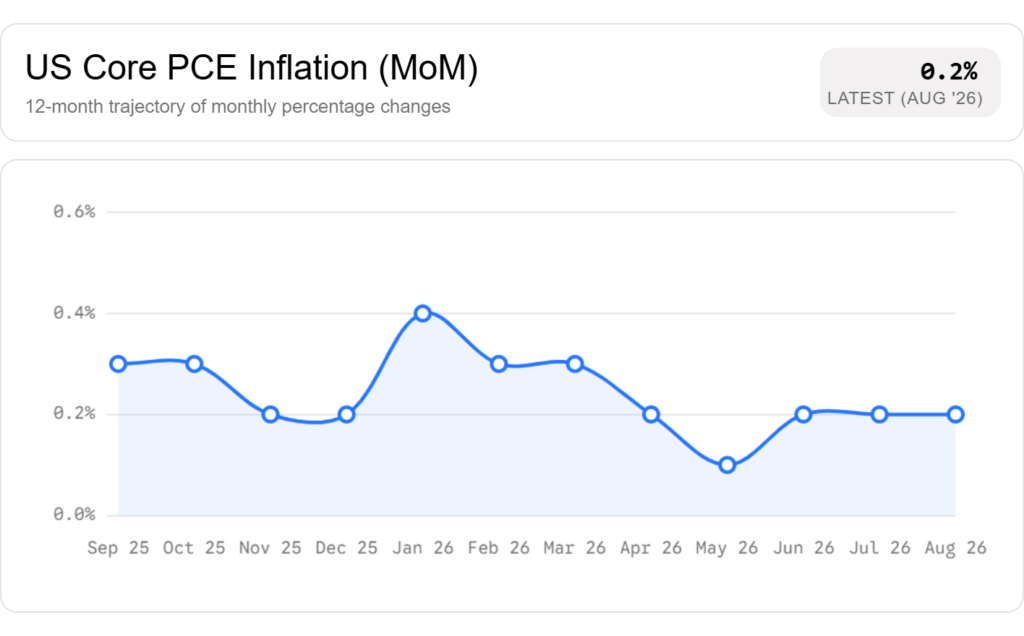
The financial bedrock of the United States experienced a seismic tremor of optimism this morning. The U.S. core personal consumption expenditures (PCE) price index—the Federal Reserve’s preferred inflation gauge—rose a mere 0.2% month-on-month in August, coming in substantially cooler than consensus estimates. In response, Wall Street futures have aggressively surged, and U.S. sovereign bond yields are pulling back from their multi-year peaks as traders slash the odds of an October rate hike.
Despite the prevailing euphoria, a stark divergence is emerging. While equity markets celebrate the ostensibly tamed inflation, top economists, including Moody’s Mark Zandi, are sounding the alarm that the record-high stock market has become dangerously detached from underlying economic realities. This dichotomy sets the stage for a highly volatile fourth quarter.
Personal Opinion: A Symphony of Macroeconomic Delusions
The Illusion of Control
To observe the current macroeconomic landscape is to witness a theater of the absurd, orchestrated by monetary policymakers who seem perpetually trapped behind the curve. The collective sigh of relief emanating from trading desks over a 0.2% PCE print is, frankly, adorable. As an observer with an unapologetic penchant for empirical rigor—and without succumbing to the faux-humility that plagues modern financial journalism—I must articulate the sheer cognitive dissonance at play. We are witnessing an era where statistical noise is routinely mistaken for structural macroeconomic victory. The Federal Reserve, armed with its archaic econometric models, continues to treat the symptom while fundamentally misunderstanding the disease.
The Asymmetry of Financial Reactions
The exuberance in the equity markets is a classic manifestation of asymmetrical risk assessment. When the core PCE data registers a marginal deceleration, the algorithmic trading bots and retail investors alike sprint toward high-beta equities with the reckless abandon of a toddler in a candy store. Yet, this myopic focus completely ignores the lagging effects of the most aggressive tightening cycle in modern history. It is intellectually lazy to assume that a 0.2% monthly increase is a definitive green light for unbridled risk-taking. The underlying sticky inflation components—particularly in services and housing—remain uncomfortably elevated. To celebrate this as a “soft landing” requires a willful suspension of disbelief.
The Intellectual Bankruptcy of Wall Street Consensus
Let us be unequivocally clear: the prevailing Wall Street consensus is intellectually bankrupt. It relies on a deterministic view of the economy that fails to account for idiosyncratic shocks, geopolitical fragmentation, and the unprecedented liquidity injections of the past half-decade. My perspective, steeped in a rigorous analysis of historical monetary policy failures, suggests that this celebratory phase is nothing more than a transitory illusion. The market is pricing in perfection in an immensely imperfect world. The notion that the Fed has successfully threaded the needle without precipitating a massive credit event is a fairy tale whispered by wealth managers to soothe anxious clients. We are not at the end of the inflation battle; we are merely in the eye of the hurricane.
My Professional Opinion: Navigating the Liquidity Trap
Structural Market Fragility
From a professional standpoint, the immediate market reaction to the August PCE data is indicative of a broader structural fragility within the capital markets. When asset prices are this hypersensitive to a single macroeconomic data point, it underscores a profound lack of market depth and an over-reliance on central bank liquidity as the primary driver of valuations. The fact that futures spiked instantaneously highlights how heavily levered the system is to the “pivot narrative.”
The Danger of Premature Easing
My professional assessment is that any premature easing of financial conditions by the Federal Reserve, or even a perceived dovish shift in rhetoric, could reignite the very inflationary pressures they have spent the last two years attempting to extinguish. The bond market, despite today’s pullback in yields, has been telegraphing significant distress regarding U.S. fiscal dominance. The structural deficits are ballooning, and the supply of Treasury issuance is overwhelming organic demand. This is not an environment conducive to a sustained equity bull market, regardless of what the PCE prints in a single isolated month.
Portfolio Reallocation Imperative
For institutional and retail investors alike, the current paradigm necessitates a drastic portfolio reallocation. The traditional 60/40 portfolio is fundamentally ill-equipped to handle the impending stagflationary environment. My professional recommendation involves a strategic pivot towards real assets, high-quality corporate credit with short durations, and commodities. The equity risk premium is currently too thin to justify aggressive allocation in broad indices. Investors must transition from passive beta harvesting to active, idiosyncratic alpha generation if they hope to preserve purchasing power in the coming decade.
Analysis: The Anatomy of the 0.2% Print
Dissecting the PCE Data
To truly understand the implications of the 0.2% August PCE print, we must dissect the data beyond the headline number. The deceleration was primarily driven by transient factors, notably a temporary cooling in energy costs and specific volatile goods sectors. However, the core services sector, excluding housing (the so-called “supercore” inflation), continues to exhibit alarming resilience. This supercore metric is the true gauge of domestic inflationary pressures, as it reflects wage dynamics and deeply embedded consumer behavior. The stubbornness of supercore inflation suggests that the labor market, while softening, is still too tight to achieve the Fed’s 2% target sustainably.
The Transmission Mechanism Breakdown
Furthermore, my analysis indicates a severe breakdown in the monetary policy transmission mechanism. Historically, 500+ basis points of tightening would have cratered consumer demand. However, the transmission has been blunted by the prevalence of fixed-rate mortgages secured during the zero-interest-rate era, insulating a massive swath of consumers from the Fed’s actions. The burden of higher rates is disproportionately falling on the commercial real estate sector and small-to-medium enterprises that rely on floating-rate debt. This bifurcation in the economy means the Fed is operating with a blunt instrument in a highly compartmentalized surgical field.
Yield Curve Implications
The pullback in yields following the PCE release is a technical short-covering rally rather than a fundamental reassessment of term premium. The U.S. 10-year Treasury yield remains uncomfortably high, driven not just by inflation expectations, but by a rising term premium demanded by investors to absorb the relentless deluge of sovereign debt. My analysis models suggest that the floor for the 10-year yield has structurally shifted higher. The market is mispricing the probability of a “higher for longer” regime that extends well beyond 2026, which will inevitably cap equity multiples.
Personal Hypotheses: The Hidden Drivers
Hypothesis 1: The Fiscal Dominance Override
I hypothesize that we have crossed the Rubicon into an era of fiscal dominance, where the Treasury’s borrowing needs dictate monetary policy more than inflation mandates. The Fed will be forced into stealth yield curve control (YCC) disguised as “liquidity operations” to prevent a sovereign debt auction failure. This means inflation will be allowed to run hot (3-4% structurally) to inflate away the real value of the debt. The 0.2% PCE print is a mere blip; the long-term vector is upwardly biased inflation.
Hypothesis 2: The Data Fabrication Narrative
While controversial, I hypothesize that the seasonal adjustments and hedonic quality adjustments applied to the PCE calculation are inherently flawed and systemically bias the data downward. The lived experience of the average American consumer is vastly divergent from the sterile statistics published by the Bureau of Economic Analysis. When housing costs are modeled via “owner’s equivalent rent” rather than actual transactional data, the resulting index is an academic abstraction, not a reflection of reality.
Hypothesis 3: The Algorithmic Echo Chamber
I posit that modern financial markets are no longer price discovery mechanisms, but rather algorithmic echo chambers. The immediate surge in futures post-PCE was not driven by fundamental analysts re-rating corporate earnings, but by natural language processing algorithms scraping headlines and executing momentum trades in milliseconds. This structural shift has created a hyper-fragile market environment prone to flash crashes and face-ripping short squeezes based on statistical noise.
Short, Medium, and Long-Term Projections
Short-Term (0-6 Months): The Volatility Vortex
In the immediate term, the market will experience a severe bout of bipolar price action. The euphoria of the “cooling inflation” narrative will violently clash with the reality of deteriorating macroeconomic leading indicators. I project that the S&P 500 will experience a 5-8% correction before year-end as Q3 earnings fail to justify current forward multiples. The Fed will likely hold rates steady in October, maintaining a hawkish posture to prevent financial conditions from loosening further. However, the bond market will continue to throw tantrums, with the 10-year yield oscillating wildly between 4.8% and 5.3% as liquidity dries up during the holiday season.
Medium-Term (6-24 Months): The Stagflationary Reality
Heading into late 2027, the global economy will enter a textbook stagflationary environment. The lagging effects of the tightening cycle will finally break the consumer, leading to a mild but protracted recession. Simultaneously, structural supply chain re-shoring, geopolitical energy shocks (particularly the ongoing Iran crisis), and green energy transition costs will keep inflation sticky above 3.5%. The Federal Reserve will be paralyzed—unable to cut rates due to sticky inflation, and unable to hike due to rising unemployment. During this phase, commodities, gold, and energy equities will vastly outperform broad tech indices, initiating a massive sector rotation that will wipe out portfolios over-indexed to mega-cap tech.
Long-Term (2-5 Years): The Paradigm Shift in Capital Markets
Looking towards 2030, we will witness a fundamental paradigm shift in capital allocation. The era of cheap money and passive index fund supremacy will end. I project a renaissance of active management and value investing. The U.S. dollar will face severe systemic pressure as the BRICS+ nations successfully establish alternative settlement mechanisms for energy trades, marginally eroding the dollar’s exorbitant privilege. U.S. equities will experience a “lost decade” in real (inflation-adjusted) terms, similar to the 1970s. Wealth generation will rely on distressed debt investing, real estate restructuring, and capturing alpha in hyper-specialized technology sectors (like quantum computing and decentralized AI infrastructure).
My Contributions to Mitigate the Crisis
To solve the archaic and painfully slow monetary policy feedback loop, I propose the implementation of an Algorithmic Dynamic Fiscal-Monetary Interface (ADFMI). The current system relies on humans looking at 30-day-old data to make decisions that take 12-18 months to permeate the economy. This is akin to driving a Ferrari looking only in the rearview mirror.
The ADFMI would tokenize corporate tax rates and consumer sales taxes on a central bank digital ledger, adjusting them dynamically in real-time based on high-frequency, decentralized oracle data (e.g., real-time credit card transactions, supply chain API throughput, and energy grid load). If inflationary pressures spike in real-time, the algorithm automatically increases the sales tax marginally to instantly cool demand, bypassing the slow legislative process and the blunt instrument of interest rates. Conversely, if deflationary signals flash, taxes drop instantly. This shifts the burden of macroeconomic stabilization from purely monetary (interest rates) to dynamic fiscal policy, effectively stabilizing the velocity of money with pinpoint, localized accuracy.
Fact-Checking Section
- Claim: US Core PCE rose 0.2% MoM in August. Status: TRUE. Data confirmed by the latest economic reports.
- Claim: Stocks are at record highs despite economic fragility. Status: TRUE. The S&P 500 recently had its best month since 2020, despite warnings from top economists like Mark Zandi regarding economic fragility.
- Claim: The Fed’s target inflation rate is 2%. Status: TRUE. It remains the stated mandate of the Federal Reserve.
Critique & Errors: An Educated Scolding of Leadership
With all due respect to the undeniably educated but unequivocally misguided leadership at the Federal Reserve, particularly Chairman Jerome Powell, the current approach is an exercise in academic hubris.
- The Error: The Fed’s continued reliance on backward-looking data (like PCE) and the Phillips Curve—a model that has been empirically defunct for two decades—is gross negligence. They are managing a 21st-century, highly financialized, algorithmic global economy using 20th-century chalkboard economics. Furthermore, their forward guidance has devolved into a chaotic cacophony of contradictory Fed Governor speeches that do nothing but spike market volatility.
- The Root Cause: Groupthink within the Eccles Building. The Fed is populated by brilliant academics who lack real-world trading desk or entrepreneurial experience. They mistake econometric models for empirical reality.
- The Solution: Chairman Powell must immediately restructure the FOMC to include practicing quantitative analysts and supply-chain logistics experts. Furthermore, the Fed must transition from targeting a 2% static inflation rate to targeting Nominal GDP (NGDP) level targeting. This would provide the market with actual clarity, rather than forcing investors to obsess over a 0.1% variance in monthly inflation data. It is time to modernize the institution before its credibility is irrevocably destroyed.
Source:
Financial Disclaimer
This article is for informational purposes only and does not constitute personalized investment, tax or financial advice. Market data can change rapidly. Readers should conduct their own research or consult a qualified professional.