
 Eduardo Sifuentes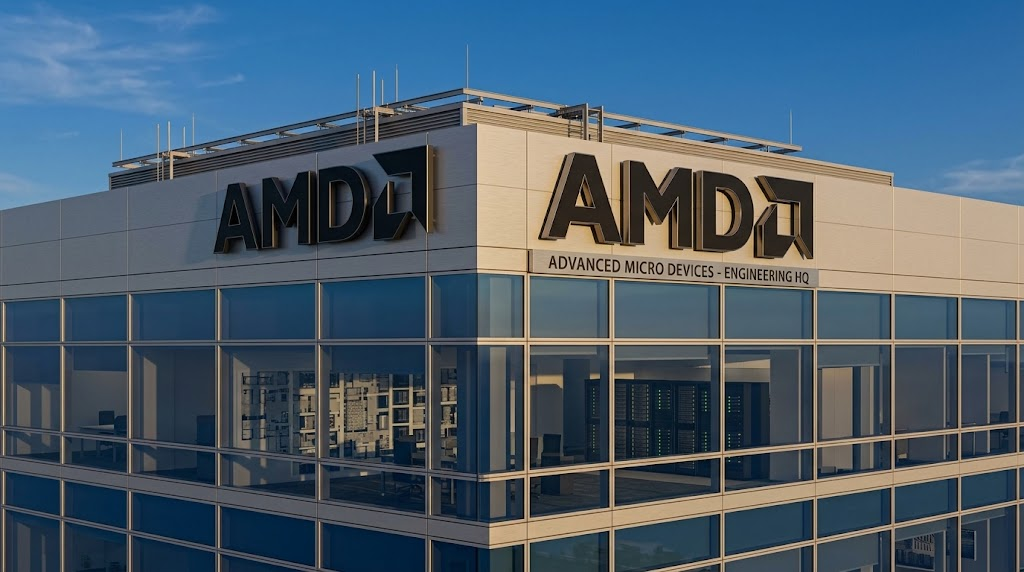
Advanced Micro Devices briefly surpassed a $1 trillion market capitalization Monday as investors increased their bets on the company’s role in artificial-intelligence computing. AMD shares rose as much as 9.6% to approximately $613.31, making it the fourth U.S. chipmaker to reach the milestone after Nvidia, Broadcom and Micron.
The company’s shares had nearly tripled during 2026, according to Reuters, reflecting a major revaluation of AMD’s AI accelerators, server processors and data-center strategy.
Why AMD reached the milestone
The rally reflects several overlapping developments:
- Stronger demand for AI computing.
- Greater confidence in AMD’s Instinct accelerator platform.
- Investor expectations that AMD can challenge Nvidia.
- Expansion from individual chips into complete systems.
- Renewed optimism across semiconductor stocks.
- Falling oil prices and easing yields improving risk appetite.
AMD was not the only chipmaker rising. Intel gained 13%, while the Philadelphia Semiconductor Index rose 2.7% in one market snapshot.
AMD’s strategic shift
AMD has moved beyond selling individual processors and is increasingly presenting complete AI systems that combine accelerators, networking and related hardware. That approach attempts to compete with Nvidia’s integrated ecosystem rather than fighting only on chip specifications.
This distinction matters because AI customers do not purchase chips in isolation. They need:
- Compute accelerators.
- CPUs.
- Networking.
- Memory.
- Software.
- Cooling.
- Data-center integration.
- Technical support.
A complete system can make a supplier more valuable, but it also increases execution complexity.
The valuation problem
A $1 trillion market capitalization is a measure of investor expectations, not a guarantee of future revenue.
MarketBeat data cited an approximate P/E ratio near 157 and a consensus “Moderate Buy” rating with an average target of $565.12.
Those figures are time-sensitive and should be verified before publication. The essential point is that AMD’s valuation leaves little room for operational disappointment.
A company can have a brilliant future and an expensive stock simultaneously. These propositions are not contradictory. They are the reason investors argue about valuation instead of merely celebrating growth.
My professional opinion
My opinion is that AMD’s $1 trillion milestone is strategically impressive but financially unforgiving.
AMD has earned investor confidence by becoming a credible alternative in AI hardware. But the market is now pricing AMD as though strong execution is the default outcome rather than the difficult achievement it actually is.
That is where investors can become intellectually lazy. A large addressable market is not the same as captured revenue. A powerful chip is not the same as a complete software ecosystem. A major customer announcement is not the same as durable gross margin.
The company’s next challenge is not persuading investors that AI is large. Everyone already believes that. The challenge is proving that AMD can convert AI demand into sustained free cash flow without sacrificing pricing discipline.
Personal hypotheses
Short term
The stock may remain momentum-driven, particularly if semiconductor peers continue rising and new AI partnerships produce additional headlines.
Medium term
AMD’s performance will depend on accelerator deliveries, software adoption, supply-chain capacity and whether customers diversify beyond Nvidia.
Long term
AMD could become a durable second major AI-computing platform, but only if it builds a software ecosystem and support network capable of retaining enterprise customers.
Fact-check and possible errors
Error 1: “AMD is now worth more than Nvidia.”
False. AMD crossed $1 trillion, but Nvidia’s valuation was reported above $5 trillion.
Error 2: “The $1 trillion milestone proves AMD is fairly valued.”
No. Market capitalization reflects current expectations, not intrinsic value.
Error 3: “AI demand eliminates execution risk.”
No. Supply chains, software and customer concentration remain risks.
Error 4: “AMD is only a GPU company.”
The company is expanding its systems strategy across processors, accelerators and networking.
What AMD should improve
AMD should:
- Publish clearer AI revenue and margin metrics.
- Expand software compatibility and developer tools.
- Demonstrate delivery reliability.
- Reduce customer-concentration risk.
- Explain data-center return economics.
- Maintain pricing discipline.
- Avoid overpromising future capacity.
- Report recurring software and services revenue separately.
If management wants investors to value AMD as a platform company, it must disclose platform economics rather than relying primarily on hardware enthusiasm.
Bottom line
AMD briefly joined the $1 trillion chipmaker club as investors bet on its expanding role in AI computing.
The milestone is a vote of confidence, but it also creates a higher standard: AMD must now prove that its AI opportunity can produce durable, profitable growth.
Source:
- Reuters AMD report
- AMD investor relations
- AMD SEC filings
- U.S. Department of Commerce semiconductor resources
- MarketBeat valuation data
- preCharge News